
 By Book Club Team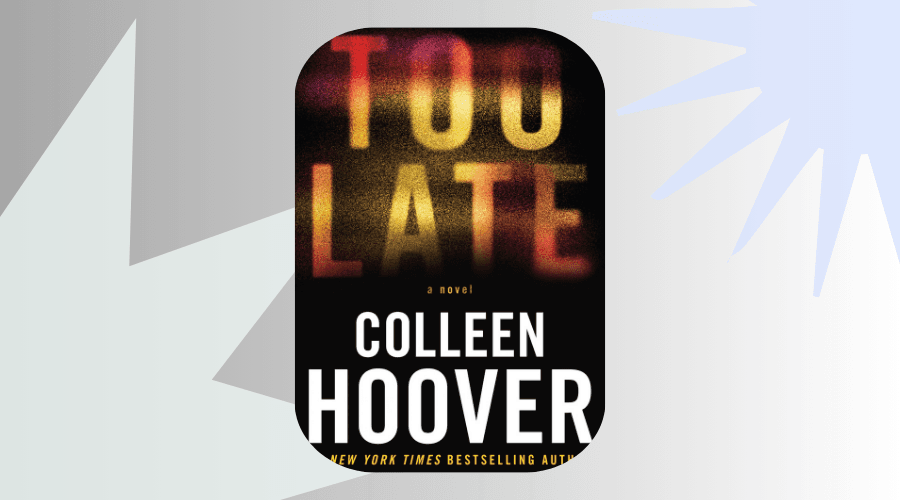
If you’re looking for a clear Too Late book summary, here’s the short version: Too Late by Colleen Hoover is a dark romantic thriller about a young woman named Sloan who feels trapped in a dangerous relationship with Asa, a possessive drug dealer whose obsession shapes every part of her life. When Sloan meets Carter, a man who seems far more trustworthy than anyone else in Asa’s orbit, the story turns into a tense mix of attraction, fear, secrecy, and survival.
This is not a light romance, and it definitely is not one of those stories where a little bad behavior is supposed to look charming. Too Late is interested in power, control, trauma, and the difference between genuine love and something much darker. If that sounds like the version you wanted, keep reading for a fuller breakdown of the plot, main characters, themes, and ending.
Too Late at a Glance
- Author: Colleen Hoover
- Genre: Dark romance, suspense, thriller
- Main conflict: Sloan is caught in the grip of an abusive and obsessive man while trying to protect the people she loves.
- Tone: Intense, emotional, claustrophobic, and unsettling
- Best for readers who want: A romance-adjacent story with high stakes, danger, and morally messy choices
It’s also worth saying up front that this novel deals with abusive behavior, manipulation, drug-related crime, and traumatic situations. For some readers, that intensity is exactly what makes the book gripping. For others, it’s what makes the novel a difficult read.
Spoiler-Free Summary of Too Late
Sloan is trying to survive a life she never really chose. She is tied to Asa, a man with money, power, and a terrifying need to control her. He can be magnetic on the surface, but underneath that surface he is deeply unstable, possessive, and cruel. Sloan stays close to him not because she feels safe, but because leaving him feels dangerous and because her circumstances leave her with very few good options.
Into that world comes Carter. He is calm where Asa is explosive, observant where Asa is impulsive, and he sees Sloan as a person rather than a possession. Their connection creates the emotional center of the novel, but it also raises the danger immediately. In Asa’s world, attention is dangerous, desire is dangerous, and hope might be the most dangerous thing of all.
From there, the novel builds tension by asking whether Sloan can actually escape, whether Carter is as trustworthy as he seems, and how much damage Asa is willing to do once he believes he is losing control.
Full Too Late Book Summary
The novel opens with Sloan living under the shadow of Asa’s influence. Asa is not simply an overbearing boyfriend. He is the center of a threatening world built on money, drugs, intimidation, and fear. Sloan’s life has narrowed around him. She has learned how to manage his moods, how to stay alert, and how to endure a situation that feels increasingly impossible to survive in any healthy way.
One of the book’s central emotional truths is that Sloan’s relationship with Asa is rooted in coercion more than choice. She is not free in any meaningful sense. She may still be standing, still functioning, still making decisions from moment to moment, but the novel makes clear that abuse can distort what “choice” even means. Sloan is constantly calculating risk: what will keep her alive, what will keep the people she cares about safe, and what will trigger Asa’s rage.
When Carter enters the picture, Sloan notices almost immediately that he doesn’t quite fit the world around Asa. He is attentive, watchful, and much harder to read than the other people in Asa’s circle. Their connection grows in small moments at first, which matters because Too Late is not really built on carefree romantic chemistry. Instead, it builds emotional intimacy through contrast. Carter offers Sloan something she has almost forgotten how to recognize: steadiness.
That growing connection becomes the engine of the novel. Sloan begins to imagine that life could be different, and that possibility changes everything. At the same time, Asa becomes more suspicious and more volatile. He already sees Sloan as something that belongs to him, so any shift in her attention feels like a direct threat to his identity and control. The result is a story that becomes increasingly tense, because the reader knows Asa is not the kind of man who will simply accept loss.
As the plot moves forward, the book reveals that Carter is carrying secrets of his own. Without giving away every plot point in the broadest possible terms, his presence in Asa’s life is not accidental. The deeper the story goes, the more it becomes clear that larger forces are closing in around Asa’s criminal world. That twist matters because it changes the novel from a story of private terror into a story where personal danger and outside pressure begin colliding.
Sloan is then pushed into even more impossible emotional territory. She wants safety, but trusting the wrong person could destroy her. She wants connection, but feeling too much could make her vulnerable. She wants out, but escape from someone like Asa is never simple. The book keeps returning to that brutal fact: leaving an abuser is often the most dangerous moment, not the safest one.
Meanwhile, Asa’s character becomes even clearer. He is not just jealous or damaged in some vague literary sense. He is driven by entitlement, obsession, and a refusal to see Sloan as fully separate from himself. In another kind of book, a writer might try to soften that through charisma. Too Late does something more disturbing. It shows how charisma can coexist with violence, and how obsession often disguises itself as devotion.
The final portion of the novel becomes a race between exposure and collapse. Hidden truths come out. Asa’s control starts to crack. Sloan is forced to decide how much she is willing to risk for a future beyond fear. Carter’s role becomes more central, not just as a love interest, but as part of the wider unraveling of the world Asa built around intimidation and control.
By the end, the novel moves toward confrontation and release. Sloan’s story is not about magically undoing trauma; it is about surviving long enough to imagine another life. The ending offers relief, but it does not pretend that relief erases what came before. That’s part of why the book lingers with readers. Even when the central threat is addressed, the emotional damage still matters.
Main Characters in Too Late
Sloan
Sloan is the emotional anchor of the novel. She is not powerful in the obvious sense, but she is resilient, observant, and constantly working to endure an impossible situation. What makes her compelling is that her strength does not look glamorous. It looks like caution, sacrifice, and surviving one day at a time.
Asa
Asa is one of the book’s most disturbing figures because he is built around obsession rather than love. He wants control, access, and possession. He may convince himself that what he feels is devotion, but the novel repeatedly shows that real love cannot exist without freedom. Asa is frightening precisely because he confuses intensity with intimacy.
Carter
Carter represents both danger and possibility. He enters the story with his own secrets, but he also gives Sloan a glimpse of what honesty, care, and protection might look like. His importance is not just romantic. He helps shift the novel from endurance toward action.
Major Themes in Too Late
1. Love vs. Obsession
The biggest theme in Too Late is the difference between genuine love and possessive obsession. Asa believes his feelings justify his behavior, but the novel rejects that idea again and again. Love values the other person’s humanity. Obsession tries to erase it.
2. Survival Under Coercion
Sloan’s story is less about why she stays and more about what it means to survive when your options have been narrowed by fear. The book understands that outside observers often judge trapped people too quickly. Sloan is making decisions from inside a system built to control her.
3. Power and Control
Nearly every relationship in the book is shaped by unequal power. Asa uses money, access, fear, and emotional manipulation to dominate others. That makes the novel feel claustrophobic, but it also gives the story its moral force. It is a book about what happens when control becomes a person’s entire way of relating to the world.
4. Hope as Risk
One of the most interesting things about the novel is that hope is not presented as simple comfort. For Sloan, hope is dangerous. The moment she begins to imagine a different future, she also has more to lose. That gives the romance element its tension. Wanting something better is emotionally necessary, but it also raises the stakes.
Too Late Ending Explained
The ending of Too Late works best if you read it as a story about escape rather than a simple love story payoff. Yes, the romantic thread matters, but the real emotional resolution comes from the possibility of Sloan reclaiming agency. The point is not just that Asa loses control. The point is that his version of “love” is finally exposed as destructive, unsustainable, and empty.
Carter’s role in the ending is important because he represents a different model of connection. He does not erase Sloan’s past, rescue her into instant emotional wholeness, or make the trauma disappear. Instead, he stands for trust, patience, and the possibility of a safer future. That is a more grounded and, frankly, more convincing kind of happy ending for a book this dark.
If the ending feels messy or emotionally bruised, that is part of the novel’s logic. Too Late is interested in what survival costs. It allows for relief, but it does not pretend that terror leaves no aftermath.
Why Too Late Feels Different From Other Colleen Hoover Books
Readers who come to Too Late expecting a more conventional contemporary romance are often surprised by how dark and thriller-heavy it is. The romantic tension is there, but the book runs on suspense, dread, and psychological pressure more than swoony escapism. That tonal difference is a big reason the novel gets such strong reactions.
Some readers are drawn to it because it is raw, intense, and fast-moving. Others bounce off it because the darkness feels relentless. Both reactions make sense. This is not a comfort read. It is a story that wants the reader to feel trapped, uneasy, and desperate for Sloan to find a way out.
Is Too Late Mainly a Romance or a Thriller?
The honest answer is that it sits between the two, though it leans heavily into thriller territory. There is a romantic core, especially in Sloan and Carter’s connection, but the book’s momentum comes from danger rather than from relationship development alone. If you’re choosing it based on genre, think of it as a dark romantic suspense novel with a strong emphasis on psychological pressure.
Final Thoughts on This Too Late Book Summary
Too Late is a tense, uncomfortable, and very discussion-worthy novel. At its heart, it is about what happens when love is confused with ownership and what it takes for someone living under coercion to imagine freedom again. Sloan’s story works because the book never treats survival as simple, and it never mistakes obsession for romance.
If you finished the novel and felt unsettled, that reaction is probably the point. Too Late leaves readers with a big question that lingers well beyond the final pages: once someone has lived inside fear for so long, what does it really mean to be free?