
 By
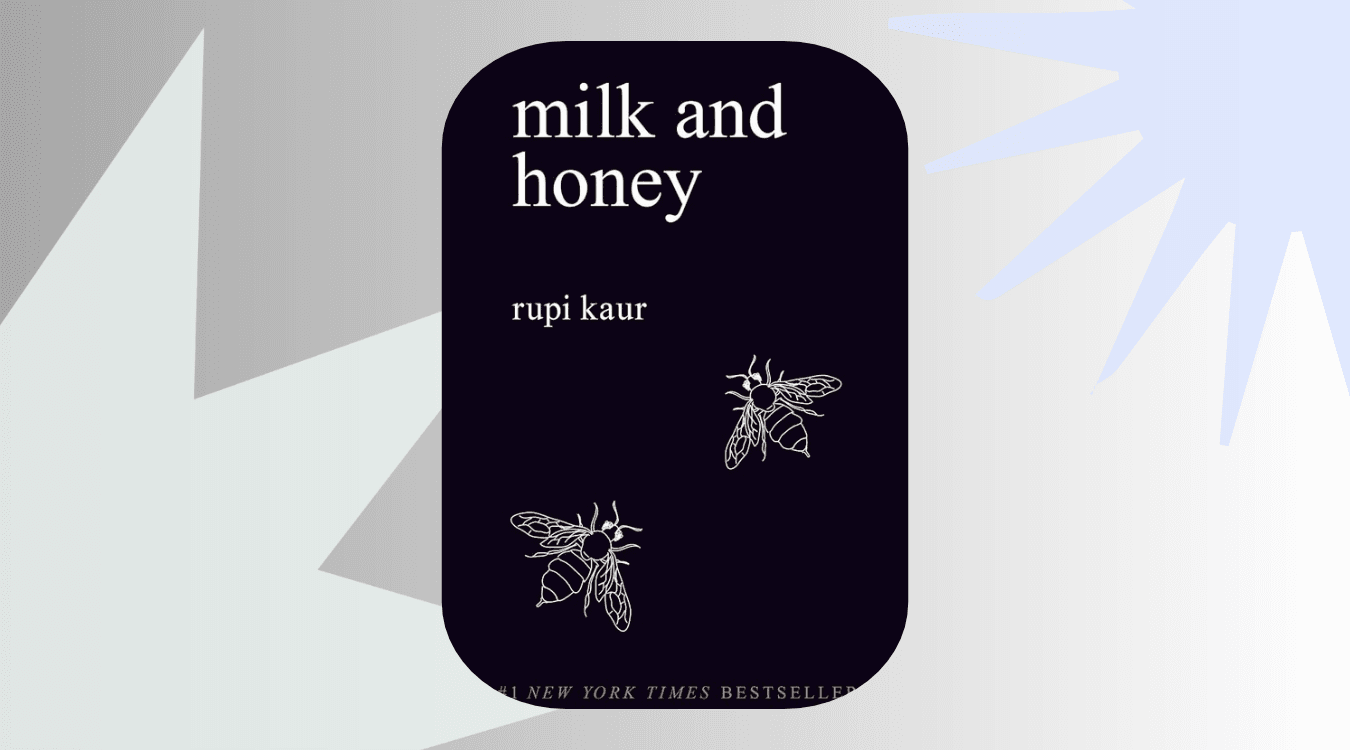
Rupi Kaur’s bestselling poetry collection traces a painful but ultimately healing emotional journey through abuse, love, loss, femininity, survival, and self-worth. Rather than telling one linear story, the book moves through a series of short poems and illustrations that chart what it feels like to be hurt, to want, to break, and then to rebuild.
That simple description gets the basics right, but it does not fully explain why Milk and Honey landed so powerfully with so many readers. The collection is intimate, direct, and often uncomfortable. It speaks in a voice that feels stripped down to the bone, which is part of why readers either connect to it deeply or argue about it passionately.
In this article, you will find a clear summary of Milk and Honey, a breakdown of its four sections, and a closer look at the book’s major themes and emotional arc.
Milk and Honey summary at a glance
Milk and Honey is a poetry collection by Rupi Kaur organized into four sections: the hurting, the loving, the breaking, and the healing. Together, these sections explore trauma, desire, relationships, heartbreak, womanhood, family, and recovery.
The book does not have a traditional plot with scenes, chapters, and rising action in the novelistic sense. Instead, it creates an emotional narrative. The speaker moves from experiences of violence and silence into romance and longing, then into separation and grief, and finally toward self-acceptance and renewal.
In that sense, the collection works less like a story you follow beat by beat and more like a record of survival. The title itself points to this contrast: life contains both bitterness and sweetness, wound and remedy, pain and nourishment.
Quick overview of the book
| Title | Milk and Honey |
| Author | Rupi Kaur |
| Form | Poetry and prose poetry collection |
| Main subjects | Abuse, love, heartbreak, femininity, identity, healing |
| Structure | Four sections that follow an emotional progression |
| Overall message | Pain can shape a person, but it does not have to be the end of their story |
How the book is structured
One of the most useful ways to understand a milk and honey summary is to look at the structure. The four-part design gives the collection its emotional logic. Even though many poems can stand alone, the sections create a clear movement from injury to restoration.
1. The hurting
The first section is the darkest. It deals with trauma, especially sexual violence, abuse, shame, and the damage done by patriarchal power. These poems are often blunt and unsettling. They present pain not as an abstract literary idea, but as something lived in the body.
This section also explores silence. Harm is not only the act itself, but the way victims are made to carry it quietly. Family dynamics, social expectations, and gendered power all contribute to that silence. The speaker is trying to name experiences that are often hidden, minimized, or denied.
The effect is intentionally jarring. Kaur does not ease readers into the material. She begins with the wound.
2. The loving
The second section turns toward romance, desire, intimacy, and the intoxicating pull of being seen by another person. After the harshness of the opening section, these poems can feel softer, but they are not exactly carefree.
Love here is both thrilling and vulnerable. The speaker experiences physical desire, emotional closeness, admiration, and longing. At the same time, there is often an undercurrent of need. Some poems suggest that love can become a place where old wounds resurface rather than disappear.
That tension matters. In Milk and Honey, love is not automatically a cure. It may feel like relief, but relief is not the same thing as healing.
3. The breaking
If the second section captures the rush of attachment, the third section shows what happens when that attachment falls apart. The breaking focuses on absence, rejection, grief, and the emotional disorientation of losing someone who had become central to your sense of self.
These poems often dwell on the aftershocks of heartbreak: replaying memories, measuring what was given and what was returned, and trying to understand whether love was mutual or uneven. The speaker is left facing not just the end of a relationship, but the painful question of how much of herself she handed over within it.
This is one reason the collection resonates with so many readers. The heartbreak in Milk and Honey is not presented as merely sad. It is destabilizing. It can make a person question their worth, judgment, and emotional habits.
4. The healing
The final section is where the book begins to breathe differently. Healing does not arrive as a neat happy ending. Instead, it appears as a gradual reclaiming of the self.
These poems shift toward restoration, self-respect, survival, and growth. The speaker starts to move away from defining herself through what others have done to her or withheld from her. There is more emphasis on boundaries, tenderness toward the self, and the possibility of becoming whole without needing external validation.
This ending is important because it keeps the collection from becoming a simple catalogue of suffering. Kaur wants pain acknowledged, but she also insists on the possibility of life after it.
A fuller summary of the emotional journey
Because Milk and Honey is not a novel, readers sometimes ask what actually “happens” in the book. The best answer is that the collection documents a transformation.
At the beginning, the speaker is shaped by violation and by the emotional habits that often follow trauma: shame, silence, confusion, and a fractured sense of self. She is trying to speak from within experiences that have left deep marks.
Then the focus shifts toward romantic and sexual connection. The speaker wants love, closeness, and recognition. She is drawn toward intimacy, perhaps partly because intimacy promises comfort, escape, and affirmation. But the relationship material in the book is rarely simple. There is pleasure, but there is also imbalance. The speaker often seems to give more than she receives or to search for completion in another person.
When the relationship or relationships fracture, the collection enters a period of grief. The speaker confronts abandonment, disappointment, and the emotional emptiness that follows intense attachment. Heartbreak becomes another form of pain layered on top of earlier wounds.
Finally, the speaker begins the difficult work of returning to herself. This does not erase the past. Rather, it changes her relationship to it. She becomes more able to name harm, more willing to value herself, and less dependent on the approval or presence of others. By the end, the collection suggests that healing is not forgetting. It is learning to live without letting pain become your only language.
Main themes in Milk and Honey
Trauma and survival
The most obvious theme in the book is trauma, especially trauma experienced by women in personal and social contexts shaped by male power. Kaur returns again and again to the ways violence lingers in memory, identity, and the body.
But the collection is not only about trauma. It is also about survival. The speaker is still here, still speaking, still trying to transform what happened into language. That act of speaking matters. In a book so interested in silence, voice becomes its own kind of resistance.
Love and dependency
Another major theme is the difference between love and emotional dependency. The collection shows how desire can be tangled up with old hurt. Sometimes what looks like love may also be hunger, insecurity, or the wish to be repaired by someone else.
This is part of what gives the romance poems their edge. They are not simply celebratory. They ask whether intimacy can become another site of imbalance if a person enters it already wounded and unsure of their worth.
Womanhood and patriarchy
Milk and Honey is also deeply concerned with what it means to move through the world as a woman. The poems touch on beauty standards, objectification, family expectations, sexual violence, and the ways girls are taught to shrink themselves.
Kaur’s feminist concerns are not laid out as theory. They show up in everyday emotional realities: who is allowed to take up space, who is taught to endure, who is expected to give, and who gets believed when harm occurs.
The body as memory
In this collection, the body is never just physical. It carries memory, desire, injury, and history. Pain is felt bodily, and so is love. This gives many of the poems their immediacy. Feelings are not treated as distant ideas floating in the mind. They live in skin, touch, appetite, and absence.
The body can be a site of violation, but it can also become a place of reclamation. That shift is central to the final section.
Healing and self-worth
The closing movement of the book emphasizes self-respect and recovery. Not every reader will find this section equally powerful, but it is crucial to the collection’s overall meaning. Kaur is arguing that survival alone is not the endpoint. The deeper goal is to rebuild a relationship with the self.
This includes learning not to beg for love, not to confuse suffering with devotion, and not to keep offering yourself where you are diminished. The healing poems often sound like reminders the speaker is teaching herself to believe.
Why the title Milk and Honey matters
The title captures the book’s central contrast. Milk suggests nourishment, care, motherhood, softness, and what sustains life. Honey suggests sweetness, pleasure, and natural richness. Put together, they evoke comfort and abundance.
Yet the poems themselves contain so much pain that the title almost feels ironic at first. That tension is the point. The collection insists that sweetness and suffering can exist side by side. What feeds us may come after what wounds us. Or, more uncomfortably, love itself may contain both tenderness and harm.
The title also helps explain the book’s appeal. Readers are not just getting darkness. They are getting a movement through darkness toward something gentler, even if that gentleness has been hard-earned.
Style and tone: why the book feels so immediate
Part of what made Milk and Honey so widely read is its stripped-down style. The poems are short, spare, and visually simple. The language is direct rather than ornate. For some readers, that accessibility is exactly the point. The poems feel emotionally available, almost like confidences shared in a quiet room or posted in the middle of the night when someone is finally telling the truth.
For other readers, the same simplicity can feel too blunt or too aphoristic. That debate is part of the book’s literary reputation. But whether a reader loves or dislikes the style, it is hard to deny that the form suits the content. Kaur writes in a way that feels immediate, vulnerable, and easy to carry into one’s own life.
The small line drawings that appear throughout the book reinforce that intimacy. They do not decorate the poems so much as echo them, giving the collection a handmade, exposed feeling.
Is Milk and Honey autobiographical?
Many readers assume the collection is purely autobiographical because of how personal it feels. It is certainly intimate, and it draws strength from the impression of lived experience. At the same time, it is still a crafted literary work. The speaker of a poem is not always identical to the author in a one-to-one way.
The more useful approach is to read the collection as emotionally personal rather than as a documentary record. What matters most is how the poems shape experience into a larger story about harm, desire, grief, and recovery that many readers recognize in their own lives.
What makes the book resonate with so many readers
There are a few reasons Milk and Honey became such a cultural phenomenon.
- It is highly accessible. Readers who do not usually read poetry often find it easy to enter.
- It names difficult experiences plainly. That directness can feel validating, especially for readers who have struggled to describe their own pain.
- It blends vulnerability with empowerment. The book acknowledges damage without staying trapped in it.
- It is easy to revisit in pieces. Many poems can be read alone, reread quickly, or shared.
At the same time, the book’s popularity has sparked criticism, especially from readers who prefer more formal complexity in poetry. That tension is worth mentioning because it helps explain the collection’s place in contemporary literature: it is not universally admired, but it is undeniably influential.
Final takeaway
The clearest milk and honey summary is that the book follows a movement from pain to healing. Through four connected sections, Rupi Kaur explores abuse, love, heartbreak, and recovery in language that is simple, intimate, and emotionally direct.
What lingers after reading the collection is not a complicated plot, but an emotional pattern: woundedness, longing, collapse, rebuilding. Some readers come to the book for comfort, others for recognition, and others for debate about what poetry can or should do. All three responses make sense.
If you are reading Milk and Honey for class, for a book club, or simply out of curiosity, it helps to approach it less as a traditional narrative and more as a sequence of emotional states. Its power lies in the way it turns private pain into a shared language, then tries to leave the reader with something gentler than despair.