
 By Book Club Team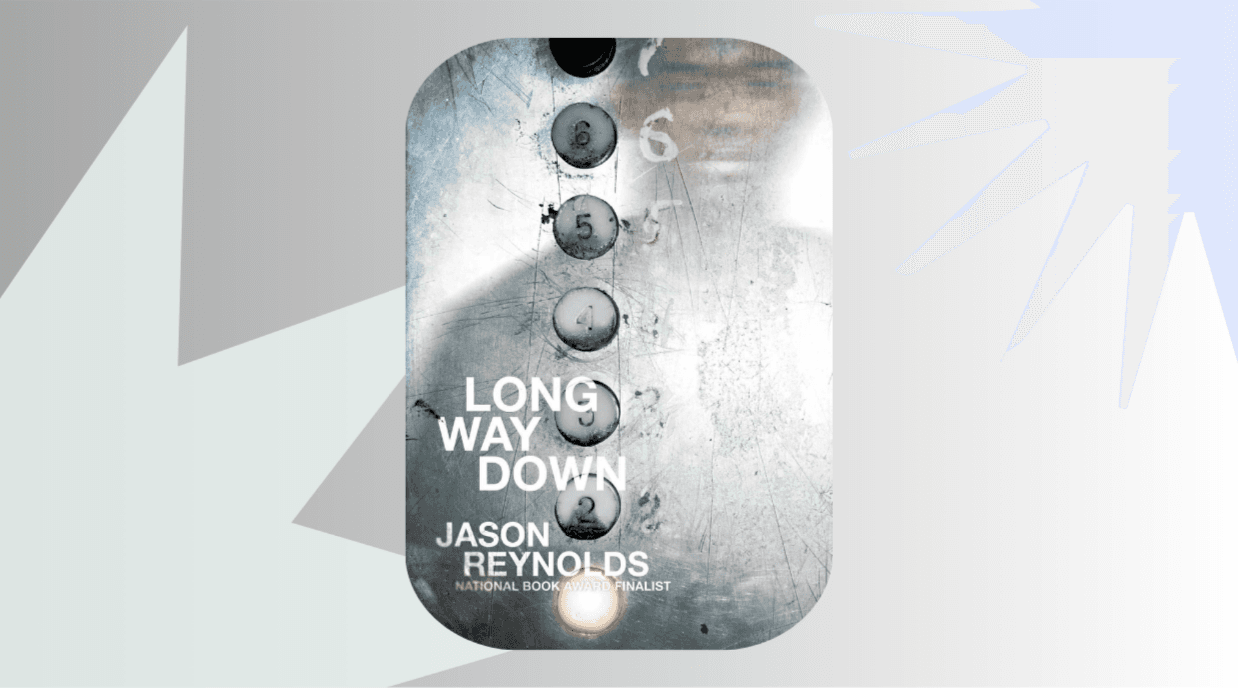
Long Way Down summary in one paragraph
Spoiler warning: This article includes major plot points and discusses the ending of Long Way Down. Jason Reynolds’s 2017 novel-in-verse follows fifteen-year-old Will after his older brother Shawn is shot. Over a single elevator ride that lasts a little more than a minute, Will meets a series of dead people tied to his family, his neighborhood, and the logic of revenge.
In Long Way Down, Will believes he already knows what comes next after Shawn’s murder: he must follow the neighborhood rules—don’t cry, don’t snitch, get revenge. He takes Shawn’s gun, gets into the elevator, and heads down to kill the person he thinks is responsible. During the ride, six dead people connected to Will, Shawn, and earlier acts of gun violence enter the elevator one by one. By the time the doors open, Will has been forced to see that revenge is never clean, certainty is fragile, and violence keeps recreating itself.
Quick overview of the book
- Author: Jason Reynolds. Long Way Down was published in 2017 and is written as a novel in verse.
- Main character: Will Holloman, a fifteen-year-old boy reeling from the murder of his older brother, Shawn.
- Set-up: Will believes Shawn’s killer is Riggs, so he takes Shawn’s gun and heads out to avenge him.
- Structure: Most of the novel unfolds during a single elevator ride, with each stop bringing another dead person into the car.
- Why it stands out: Reynolds uses fast, compressed verse and a tightly limited timeline to turn one revenge decision into a larger story about grief, masculinity, and the cycle of violence.
Full Long Way Down book summary
Shawn’s death sets the story in motion
Will has grown up with what the book calls the Rules: no crying, no snitching, and revenge. After Shawn is shot and killed, those rules feel less like ideas and more like instructions. Will goes back to the room he shared with Shawn, notices the slightly open middle drawer in Shawn’s dresser, and finds the gun hidden there. He decides he will use it to kill Riggs, the person he assumes murdered his brother. The awful logic is simple: Shawn is dead, so now Will is supposed to make someone else dead too.
The elevator becomes the novel’s pressure cooker
Once Will leaves the apartment and presses the lobby button, the book narrows into a high-pressure set piece. The elevator is both a literal ride downward and a trip through family history, neighborhood memory, and buried grief. Reynolds turns roughly sixty seconds into an emotional reckoning: each stop interrupts Will’s certainty, and each passenger complicates the neat revenge story he wants to tell himself.
Each ghost reveals another piece of the violence
The first major revelation comes with Buck, Shawn’s mentor and the man who originally gave Shawn the gun. Buck makes Will check whether the gun is loaded and reveals that one bullet is missing, which means Shawn had actually used it before. Then Dani, Will’s childhood friend who was killed by a stray bullet when they were both children, forces Will to imagine the possibility that revenge does not go according to plan. Uncle Mark adds another layer: he frames Will’s revenge plan like a movie, which makes Will hear how thin and unfinished his script really is.
Will’s father, Pop, delivers one of the novel’s hardest truths. Trying to avenge Uncle Mark, Pop killed the wrong person. That matters because it wrecks the fantasy that revenge is precise or morally satisfying. Frick, another dead rider, reveals the chain even more clearly: he killed Buck, Shawn killed Frick, and the violence kept moving forward. By the time Will realizes how many deaths are linked through fear, loyalty, error, and retaliation, the book has quietly shifted from a revenge story into an anatomy of how revenge reproduces itself.
Shawn’s appearance changes the book’s emotional center
When Shawn finally enters the elevator, the novel stops feeling like a puzzle and starts feeling like grief in raw form. Will wants Shawn’s approval. Instead, Shawn stays distant, then breaks the very rules that shaped Will’s behavior by crying. That moment matters because it exposes the emotional fraud at the heart of the Rules: they promise toughness, but they leave boys and men unable to mourn honestly or admit fear. The book ends with Shawn asking Will if he is coming, and Reynolds leaves Will’s final choice unstated.
Main themes in Long Way Down
1. Revenge is a cycle, not a resolution
If you want the central idea of Long Way Down in one sentence, it is this: violence keeps recruiting the next person in line. Almost every ghost in the elevator is there because one death led to another. The novel keeps showing that revenge feels decisive in the moment, but in practice it creates more grief, more uncertainty, and more names for the same pain. That is why the story feels so claustrophobic. The elevator is small, but the history packed inside it is enormous.
2. The Rules are really lessons about survival and damage
The three Rules do not appear out of nowhere; they are part survival code, part social pressure, and part inherited trauma. Reynolds does not write them as cartoon-villain logic. Instead, he shows how they get passed from one generation to the next until they start sounding inevitable. The tragedy is that the Rules are supposed to protect people, but the novel steadily shows that they also trap the broken into repeating the same losses.
3. Masculinity in the book is tied to silence
One of the most powerful things about the novel is how strongly it connects masculinity with emotional shutdown. Will believes that crying would make him weak. He also believes that asking questions or refusing revenge would violate the code he inherited from Shawn and the men before him. Dani and Shawn both challenge that logic from different angles, and Shawn’s tears at the end make the challenge impossible to ignore. Long Way Down is not just about guns; it is also about what boys are taught to do with sorrow when they are told they are not allowed to show it.
4. Certainty is dangerous in a world full of partial stories
At the start, Will thinks he knows exactly who killed Shawn and exactly what justice looks like. The elevator ride keeps exposing how incomplete that certainty is. He does not know the full history of Shawn’s gun. He does not know the full story of Pop’s revenge. He does not even know whether his assumption about Riggs is correct. That gap between what Will believes and what he actually knows is one of the novel’s sharpest warnings. Acting on limited knowledge is one more way violence keeps winning.
5. The verse form is not decorative; it is part of the meaning
Because the novel is written in verse, each pause, line break, and bit of white space carries pressure. The reading group materials for the book specifically call attention to format, spacing, figurative language, and anagrams because those choices shape meaning, not just style. The clipped poems make the story feel immediate, breathless, and fragile, which suits a novel taking place in barely more than a minute and inside a mind on the edge of irreversible action.
Long Way Down ending explained
The ending is famous for refusing to make the final moral choice for the reader. Shawn asks Will if he is coming, but the novel does not spell out whether Will steps off the elevator to kill Riggs, follows Shawn into death, or pauses long enough to break the cycle. Critics and reading guides alike point to the ending as deliberately ambiguous, and that ambiguity is the point rather than a trick. Reynolds leaves Will in the exact space where real moral decisions happen: not after violence, but in the second just before it.
My own reading is that the book wants us to notice the interruption more than the answer. By the time the elevator reaches the lobby, Will can no longer pretend revenge is simple, accurate, or noble. Whether he acts or not, he has seen the full inheritance attached to the gun in his waistband. In that sense, the novel’s real climax is not a shooting; it is the collapse of certainty. That is a much braver ending than a neat yes-or-no resolution would have been. This is an interpretation based on the book’s plot structure, its recurring focus on misidentification and repeated retaliation, and the way reviewers and teaching guides describe the ending’s ambiguity.
Why Long Way Down works so well for discussion
This is the kind of short book that can fuel a very long conversation. The official discussion materials emphasize questions about the Rules, the meaning of Will’s name, the use of anagrams, the effect of verse formatting, Will’s assumptions about Shawn’s killer, and whether Will is doing the right thing. In other words, the novel is built for interpretation rather than simple recall. It gives readers just enough certainty to follow the plot, then keeps opening deeper ethical and emotional questions underneath it.
- Are the Rules really about strength, or are they evidence of a community forced to live in survival mode?
- What changes Will more: the facts he learns, or the chance to finally feel grief instead of performing toughness?
- Does the ending offer hope, or does it show how hard it is to escape inherited violence even when you understand it?
- How does the verse form make the elevator ride feel faster, more intimate, and more tense than a conventional prose version might?
Final thoughts
If you came looking for a simple Long Way Down book summary, the short version is this: Will gets into an elevator planning to avenge Shawn, and by the time the doors open he has been forced to confront the human cost, uncertainty, and inherited logic behind that plan. The longer version—and the reason the book lingers—is that Jason Reynolds turns one minute of decision-making into a whole history of love, loss, fear, and pressure. It is a quick read, but absolutely not a slight one.